Research papers written for your brain.
Tell us what you want to learn, how much you already know, and how your brain works best. We deliver a polished paper you'll actually want to read.
Starting from
Delivery time
Reading styles
Same topic.
Totally different experience.
Here's what happens when a paper is built for how your brain actually works.
Abstract: The clustered regularly interspaced short palindromic repeats (CRISPR) and CRISPR-associated protein 9 (Cas9) system has revolutionized the field of genome engineering. This review examines the mechanistic underpinnings of the ribonucleoprotein complex, PAM recognition, R-loop formation, and subsequent double-strand break (DSB) generation...
The type II CRISPR system utilizes a single effector protein, Cas9, guided by a chimeric single-guide RNA (sgRNA) comprising a CRISPR RNA (crRNA) fused to a trans-activating crRNA (tracrRNA) (Jinek et al., 2012; Doudna & Charpentier, 2014). The Cas9-sgRNA complex interrogates double-stranded DNA through PAM-proximal seed region complementarity...
Off-target effects remain a significant concern in therapeutic applications. Zhang et al. (2015) demonstrated that truncated guide RNAs (tru-gRNAs) of 17-18 nucleotides can reduce off-target mutagenesis by 5,000-fold while maintaining on-target efficiency comparable to full-length guides...
CRISPR is a tool that lets scientists edit DNA like a find-and-replace in a document. It's faster, cheaper, and more accurate than anything before it. It could cure genetic diseases — but there are risks.
What is CRISPR, actually?
Think of your DNA as a massive instruction manual — about 3 billion letters long. CRISPR is basically molecular scissors that can find a specific sentence in that manual and rewrite it.
Before CRISPR, editing genes was like trying to fix a typo in a book by ripping out pages. Now it's precise — you can change a single letter.
CRISPR didn't invent gene editing — it made it accessible. What used to take years and millions of dollars now takes weeks and thousands.
Three steps.
One great paper.
Tell us what you need
Pick your topic, knowledge level, and reading style. Two-minute form. That's it.
We research & write
AI does the heavy research. A human reviews every paper for quality and accuracy.
Read & learn
Get a polished PDF formatted for how your brain works. Delivered to your inbox within 24 hours.
Four formats.
Your choice.
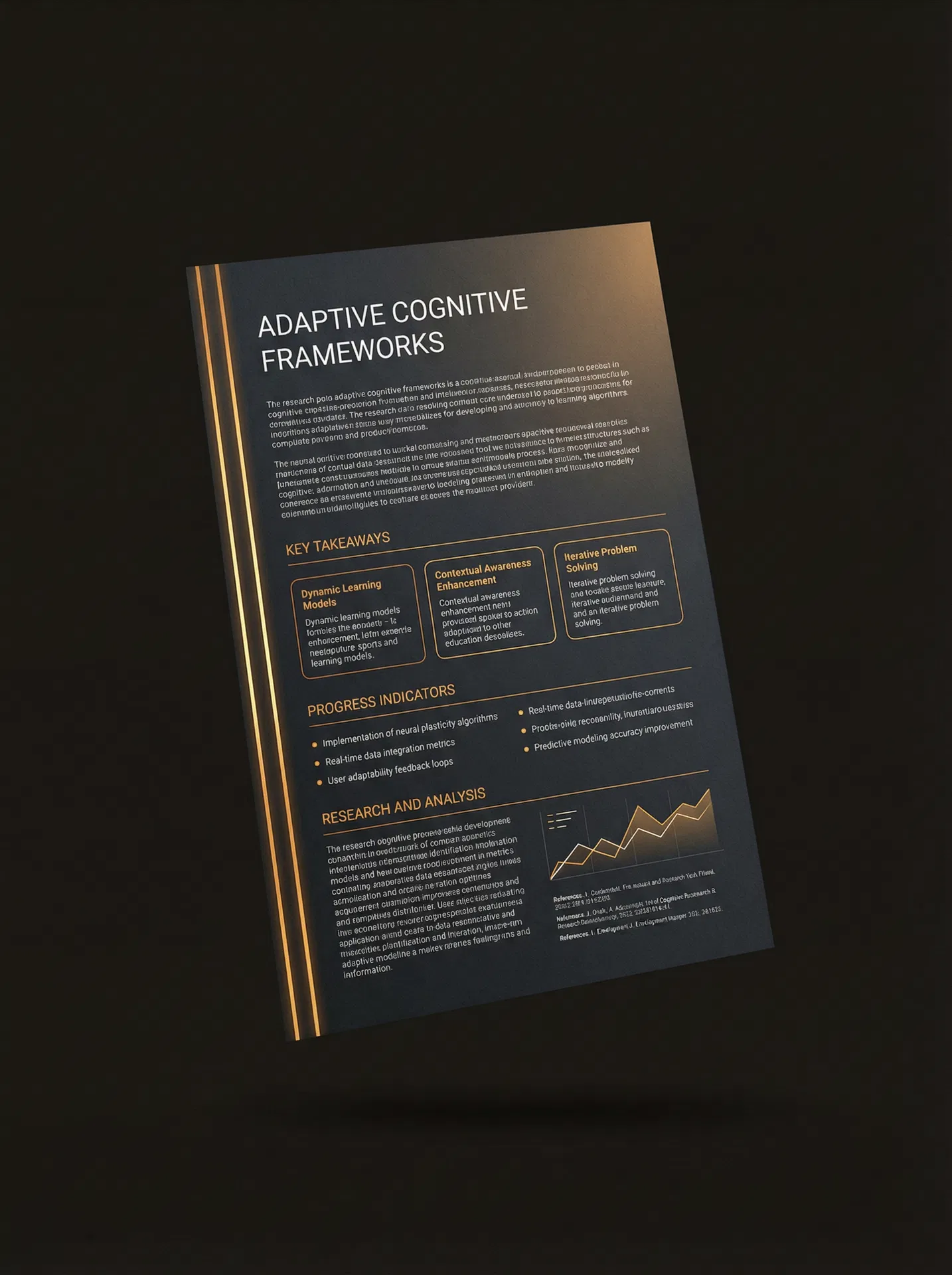
Every brain is different. Pick the format that matches how you actually absorb information.
ADHD-Friendly
Built for brains that bounce.
- Short, punchy sections with clear headers
- TL;DR at the top of every section
- Visual progress indicators throughout
- Key takeaway boxes that pop
Academic
Rigorous without the rigor mortis.
- Proper citations and methodology
- Structured abstract and literature review
- Formal tone with accessible language
- Publication-ready formatting
Visual
For people who think in pictures.
- Concept maps and diagrams throughout
- Infographic-style data presentation
- Color-coded themes and categories
- Minimal text, maximum understanding
Narrative
Research that reads like a story.
- Story-driven structure with a clear arc
- Real-world examples and analogies
- Conversational but authoritative tone
- Engaging hooks for each section
What people
are saying.
“I have ADHD and haven't finished a research paper since college. I read my DeepDive paper front to back in one sitting. That's never happened.”
Build your paper.
Two minutes. Five steps. That's it.